We have many new things to share with you, so stay tuned here on our website to stay current.
The Wenatchee Valley Erratics’ website is the showcase of our groups territory, from the Canadian Border through all of the Okanogan Lobe, to Dry Falls, Wenatchee, Leavenworth and beyond.
For 2026, we have a line-up planned of special guests and private tours.
NOTICE: The Wenatchee Valley Museum and Cultural Center will be closed from
May 18, 2026 thru 2028 for magnificent interior renovations.
During that time period, all Wenatchee Valley Erratics meetings / presentations will be held at the
Wells House, 625 Nelson Ave, Wenatchee, on the Wenatchee Valley College campus.
Further information is available by contacting
Wenatchee Valley Erratics President, Jeff Becklund, at contact@wverratics.org
Scroll down for more information.
Once every two (2) months the Wenatchee Valley Erratics provide informative, fun, interactive live presentations after our meeting.
These are free Events
open to the public and
available on zoom.
Our bimonthly meetings are combined with live “in-person” presentations from a broad spectrum of interesting guests of varied backgrounds providing facts, figures, and FUN along with high definition video and audio!
Meetings are scheduled for the following dates:
December 9, 2025
February 10, 2026
April 14 ,2026
August 11, 2026
October 13, 2026
December 8, 2026
Meetings are open to the public and located at the
Wells House, 625 Nelson Ave, Wenatchee, on the Wenatchee Valley College campus.
The April 14 presentation features Dr. E F Cater live at the
Wenatchee Valley Museum and Cultural Center,
127 S Mission Street, Wenatchee.
Gold—formed deep within the Earth under extreme heat and pressure—has captivated human curiosity for centuries.
What makes this mineral so uniquely valuable that we still use it today, even in something as small and precise as the screws in “aftermarket” body parts, electronic devices, and jewelry?
Its rarity, durability, and resistance to corrosion set it apart. Gold doesn’t tarnish, degrade, or lose its luster—qualities that make it both scientifically remarkable and economically powerful.
From 1850 to 1920, waves of hopeful prospectors surged into the area, igniting recurring gold rushes year after year. The result was a frenzy of digging, panning, and relentless pursuit.
Yet nearly 89% of those seekers walked away empty-handed.
Many lacked a fundamental understanding of the geology—how gold forms, where it concentrates, and the natural processes that hide it in plain sight.
Ironically, traces of gold can be found scattered across much of the Big Bend, but without knowledge, even abundance can remain undiscovered.
It’s a journey into the forces that shape our planet, the lessons of those who came before us, and the enduring human drive to go forth, discover, and understand.
Those fellows came rich in life experiences to hang out in the old, earthy service stations in the classic car era. Yeah, they offered uncensored lessons in dirt-and-grime humor.
With a scholarship to study at the Art Center with the college students, he went from getting down and dirty with grease and oil to coloring his hands with chalk, clay, and paint. (see image)
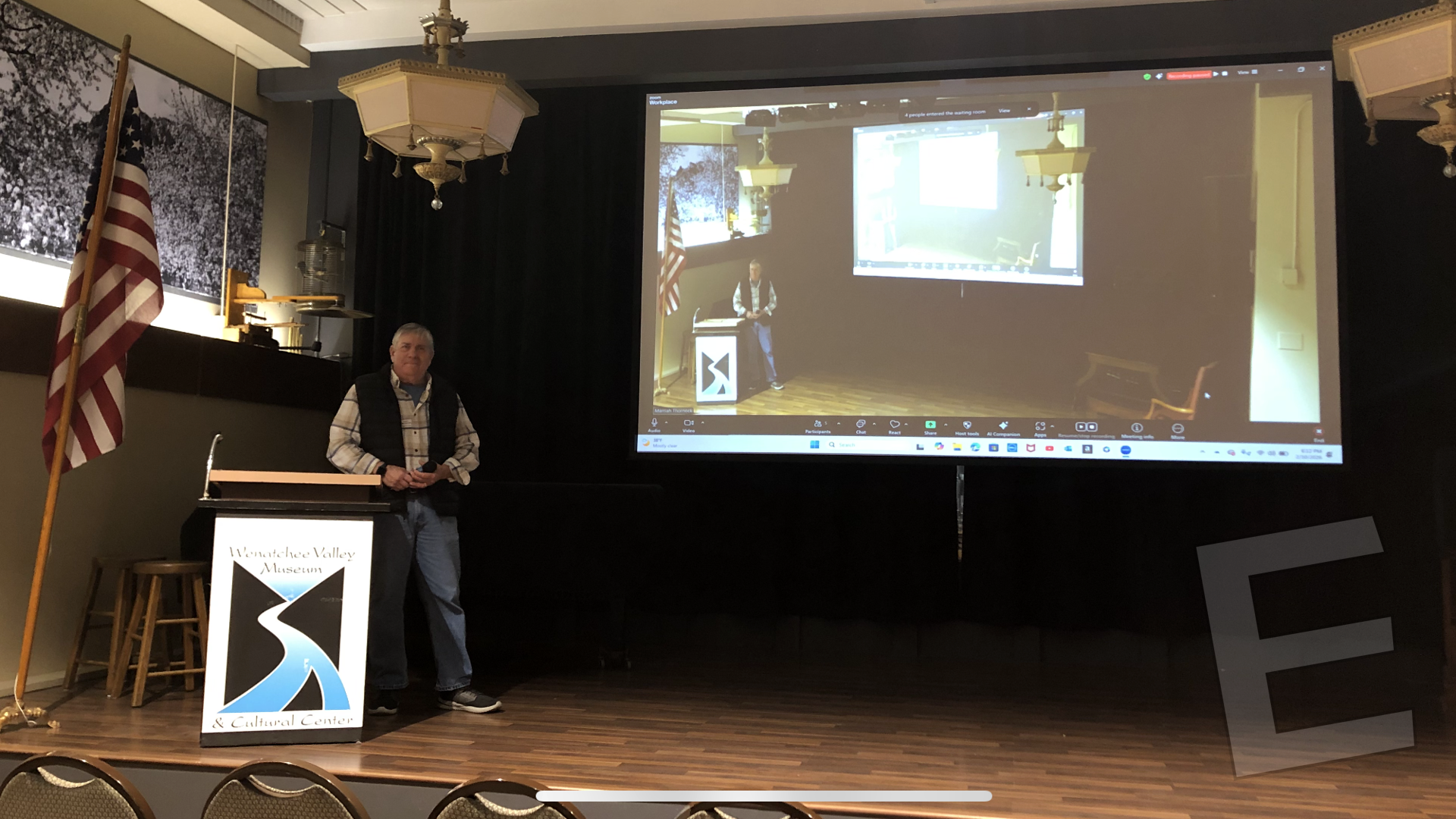
At present, he works as a freelance writer and oral storyteller while serving as the teaching pastor for an online church.The February 10 presentation featured Bill Burgel via Zoom from his home in Portland. Click Here to watch the presentation that was held at the Wenatchee Valley Museum & Cultural Center February 10, 2026.
The advent of the Industrial Revolution brought about the development of the science of geology which was followed closely by the growth of the railroad industry. A quick look at both of these disciplines over the past 200 years reveals a fascinating back and forth which resulted in amazing advances for both. For instance, geologists found the coal and then the railroads transported this coal to locations where people worked and lived. And coal mines virtually dictated where the rail line should be built. Comparisons between the two efforts continue to the present day with Bill outlining current challenges.
Back in 1995, Bill was heavily involved in the installation of a new ventilation system for BNSF’s Cascade Tunnel. He’ll spend the last 10 minutes of this lecture describing how BNSF ensures safe operations through the longest railroad tunnel in the United States.
Bill Burgel – Professional Geologist Registered in Oregon and Idaho
Bill retired in 2015 after a successful 45-year career in the railroad industry.
Bill worked for several railroads nationwide in both the engineering and operating departments.
His work for Union Pacific included the design of the first computer-aided dispatching office in the nation.
This office was located in Portland and Bill was the Regional Chief Dispatcher for several years before the office was moved to Omaha.
After retiring from the railroad in 1989, he assisted the Surface Transportation Board as their rail operations manager for two major mergers, once in Washington DC and the second time in Chicago.
Bill has managed many rail studies for both Oregon and Washington DOTs as well as for TriMet and Sound Transit in Seattle.
While working for the railroad, his interest and training in geology was often called upon to resolve landslide issues and rerouting studies, implement early earthquake warning strategies, and conduct numerous long railroad tunnel analyses.
Bill has given numerous presentations on rail issues as well as earthquake preparedness and topics pertaining to regional geology to local audiences throughout the Pacific Northwest and as a cruise ship lecturer throughout the world.
Bill lives with his wife Charlotte in Portland, Oregon.
Education:
1971 –University of Michigan –BS Engineering (with emphasis on Geologic Oceanography)
1986 –Idaho State University –MS Structural Geology
Recent Speaking Engagements:
Various audiences including a lecturer on cruise ships, Geological Society of America (GSA) annual and section meetings, Geological Society of the Oregon Country (GSOC), Central Oregon Geologic Society (COGS), Ice Age Flood Institute (IAFI) –several chapters, Portland State University, University of Oregon, Northwest Geological Society, Architectural Heritage Center, OMSI, Oregon Rail Heritage Foundation, Tualatin Historical Society, numerous Neighborhood Associations in Oregon & Washington; Monthly Talks for the Mt Tabor Urban Nature Series and for an assisted-living community located in Beaverton.
Cruise Ship Experience:
1. Princess Discovery, March –April 2024; Los Angeles to Hawaiian Islands and return; 8 lectures on Geology and Railroads
2. SilverSea Shadow, April –May 2024; Tokyo to Seward, AK; 8 lectures on Geology and Railroads
3. Viking Orion, August 2024; Vancouver BC to Seward, AK; 4 lectures on geology, flora & fauna and railroads; plus acted as ship’ naturalist; delivered program on Hubbard Glacier from ship’ bridge.
4. Viking Orion, September 2024; Seward, AK to Vancouver BC; 4 lectures on geology, flora & fauna and railroads; plus acted as ship’ naturalist; delivered program on Hubbard Glacier and Johnstone Straits from ship’ bridge.
5. Princess Ruby, September-October 2024, San Francisco to Hawaiian Islands and return; 8 lectures on Geology and Railroads
6. Azamara Onward, March-April 2025, Singapore to Bangkok; 8 lectures on Geology including a timely Mandalay Earthquake Lecture which affected our cruise.
Geology-Focus Presentations and General Geology:
1. The Columbia River –Grand Coulee Dam to Astoria: The Missoula Floods from the Seat of a Kayak
2. Lake Bonneville Flood –18,000 years Before Present
3. Missoula Flood Deposits in the Palouse –was Palouse Falls Carved in a Day?
4. Missoula Floods in the Portland-Vancouver Area: Where to See Evidence of the Ancient Floods
5. Mega-Floods Worldwide –Carving of the English Channel & the Straits of Bosporus
6. Glacial Outburst Flooding –Examples throughout the World and Mars
7. The Carving of the Straits of Bosphorus –Was this Noah’ Flood?
8. The Rapid Filling of the Persian Gulf –Did this Impact Ancient Civilizations
9. Glacial Lake Missoula and the Geology Career of USGS Scientist Joseph T Pardee
10. Glacial Erratics –Glacial Lake Allison & the Willamette Meteorite
11. Hells Canyon – One of the Youngest Canyons on Earth
12. Ancestral Columbia and Snake River Systems – Only major river system in the world to cut through a Volcanic Arc
13. Columbia River Flood Basalts – Large Igneous Province formed 16 million years ago
14. Pacific Northwest Flood Control: Columbia and Willamette River Systems
15. Geology of Oregon – A Very Young State!
16. The Mountains of St. Francis –Exploring the K-T Boundary that led to the Discovery of the Chicxulub Impact Crater –with Jan Smit & Alessandro Montanari
17. When Yellowstone was in Oregon –The Origin and Migration of the Yellowstone Mantle Plume
18. The History of Plate Tectonics: How Continental Drift Combined with Sea Floor Spreading to Create a New Scientific Paradigm (1963-1972)
19. The Hubris of Man –How Science is Ignored when Mother Nature is Talking to Us
20. Low-Angle Normal Faulting in the Hinterland of the Fold & Thrust Belt –Eastern Great Basin
21. The Ice Age in Scandinavia
22. Norwegian Quick-Clay Landslides
Volcanoes:
23. Volcanoes: Comparison of the Cascade Volcanic Arc with the Central American Volcanic Arc
24. Volcanoes in Italy & Greece –History & Current Risk
25. Volcanoes of Japan – History & Current Risk – Sakurajima Eruption
26. Volcanoes of Alaska – Why the Alaska Volcano Observatory (AVO) is so Critical for our Airline Industry.
27. Volcanoes of the Canary Islands
28. Volcanoes of Africa
29. Volcanoes around the World – How and Where Continents are being Created
Earthquakes:
30. Lahar Early Warning Systems –Why Mt Rainier is the Most Dangerous Volcano in the US
31. The 2004 Boxing Day Earthquake & Tsunami in Indonesia –World’ Greatest Train Accident
32. The 2022 Eruption of Hunga-Tonga, the Largest Eruption of Earth for the last 200 years
33. The 2011 Tohoku Earthquake in Japan –Loss of the Fukushima Nuclear Power Plant
34. Cascade Subduction Zone & Crustal Earthquakes in the Pacific Northwest –Earthquake Preparedness in the Portland/Vancouver Area
35. Early Earthquake Warning Systems and the Union Pacific Railroad
Railroad-Focus:
36. The Great Train Rides of the World
37. The Growth of the Railroad Industry and the Development of the Science of Geology
38. Train Operations through BNSF’ Cascade Tunnel
39. Train Operations in the Pacific Northwest
40. High Speed Passenger Rail –Why This Transportation Mode is Incompatible with a Freight Railroad
41. High Speed Passenger Rail –Worldwide Systems
42. High Speed Passenger Rail –Why the USA is having difficulty implementing this Transportation Mode
43. The Switch from Steam to Diesel Locomotives Happened Virtually Overnight in the US. Why was this Transformation so fast?
44. Bonners Ferry Idaho Landslide –October 1998 (or How I stayed out of Jail Twice!)
45. The 1996 Reconstruction of the Port of Tillamook RR
46. Blue Mountain Railroad Tunnel Feasibility Study –La Grande, Oregon
47. The Alaska Railroad –How this Railroad Integrates with the Cruise Ship Industry
World Geography:
48. Trade Routes (Current) –How World Trade Works between Nations or Why Outsourcing Works!
49. The Silk Road –Why Marco Polo’ Expedition in 1291 Initiated Trade Patterns That We Still See Today
50. Canals of the World –How These “rade Route Shortcuts”Make a Significant Difference to the World’ Economy
51. Flashpoints –Locations around the World where Geography and Politics Collide!
Naturalist-Focus:
52. A Naturalist’ View of Alaska –Dinosaurs in Alaska!?!
53. Beringia –How the Land Bridge in the Bering Straits affected the Migration of Civilization to the Americas
54. The Wallace Line – How Geology Shaped the Evolution of Flora & Fauna in SE Asia & Australia
Oceanographic-Focus:
55. Ocean Currents – How Our Oceans Redistribute the Heat We Received from the Sun Each Day
56. Atlantic Meridional Overturning Circulation (AMOC) –Should We be Concerned?
57. Mineralization at the Bottom of the Ocean –Is it Worth the Risk?
58. Zealandia –the 8th Continent!
History:
59. Nellie Bly – She Led the Way!
60. Narcissa Whitman –First Woman on the Oregon Trail
Click here to watch the video.
Karl Lillquist gave our final live, and Zoom, presentation for 2025. Karl is a physical geographer, who taught at Central Washington University until his retirement in summer of 2024.
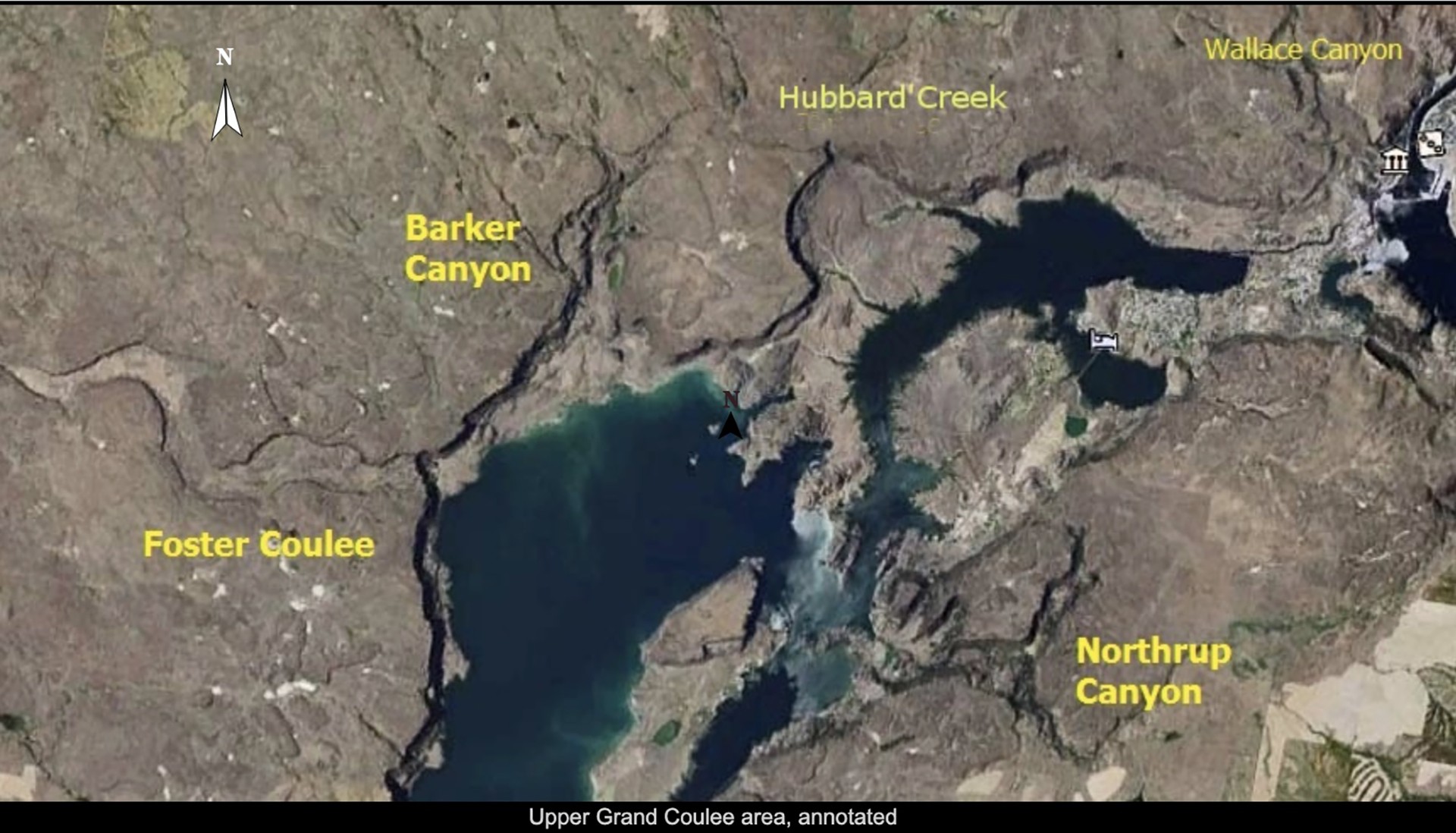
He talked about “Foster Creek and Foster Coulee: Insights on Ice Age Floods, Glaciers, and Lakes on the Waterville Plateau, WA.”
After the Grand Coulee and Moses Coulee, Foster Coulee is the largest coulee on the Waterville Plateau. During the last Ice Age (about 15,000 years ago), it was a channel for the Columbia River and a conduit for the Missoula Floods. Combined with the valley of Foster Creek, it dominates the northwest corner of the Columbia Plateau.
The program is free and open to the public.